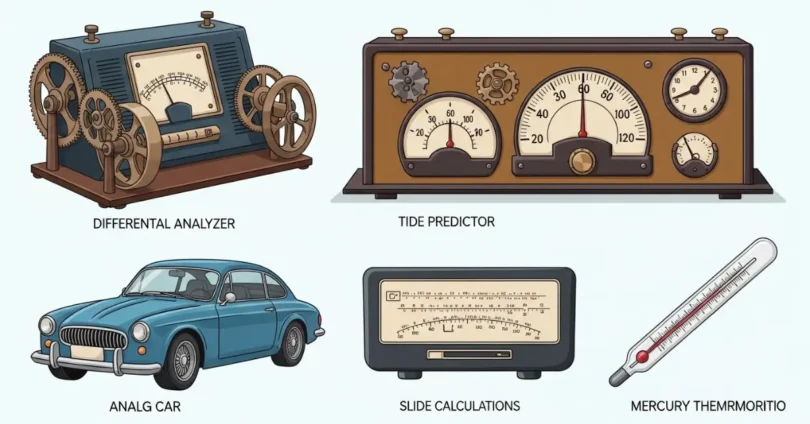
Did you know that analog computers have been around for more than a century? They are machines that work with continuous data, like speed, temperature, and voltage. Before digital computers became common, they were the main tools for solving real-world problems. In this article, we will explore what are 5 examples of analog computer and how they were used in everyday life.
What Are 5 Examples of Analog Computer
Analog computers are special machines that work with continuous data. They are different from digital computers because they measure things like speed, temperature, or voltage instead of working with numbers only. Before digital computers became common, analog computers were widely used for solving real-world problems in science, engineering, and everyday life. In this article, we will explore what are 5 examples of analog computer and explain how each one works in simple terms.
1. Differential Analyzer
The differential analyzer is one of the first analog computers. It is used to solve complex mathematical problems quickly. Scientists and engineers used it to calculate equations that were hard to solve by hand. This machine works with mechanical parts like gears and wheels to simulate real-world problems.
2. Tide Predictor
A tide predictor is a machine that helps predict ocean tides. It is very useful for ships and ports because it tells them when tides will be high or low. The tide predictor works with rotating gears and dials to simulate the movement of water. This is a perfect example of how analog computers measure and calculate natural events.
3. Analog Speedometer
An analog speedometer is found in many cars. It is an analog computer that measures speed. The needle moves smoothly on the dial to show how fast the car is going. This example shows how analog computers are used in everyday life and not just in labs or science.
4. Slide Rule
The slide rule is a manual calculating tool used by engineers and scientists before electronic calculators. It is an analog computer that helps solve math problems like multiplication, division, and roots. The slide rule works by sliding scales against each other to get results quickly.
5. Thermometer (Analog)
An analog thermometer is a simple and familiar example of an analog computer. It measures temperature using mercury or colored liquids. As the temperature changes, the liquid moves up or down, giving a clear reading. This is one of the easiest ways to see how analog computers work in real life.
What is an analog computer?
It is a type of computer that works with continuous data. They are used to measure or calculate real-world things like speed, temperature, or voltage.
What are 5 examples of analog computers?
They are:
Differential Analyzer
Tide Predictor
Analog Speedometer
Slide Rule
Thermometer (Analog)
How do analog computers work?
They are based on physical signals like rotation, voltage, or liquid movement. They solve problems by simulating real-world measurements.
Where are analog computers used?
They are used in engineering, science labs, weather prediction, navigation, and other measurement tasks.
Are analog computers still used today?
Yes, they are used in specific tasks where real-time measurements are important. However, digital computers have mostly replaced them.
What is the difference between analog and digital computers?
Analog computers work with continuous data.
Digital computers work with numbers and codes.
Analog computers are fast for some real-world tasks, but less accurate than digital computers.
Why were analog computers important?
They are early computing tools. They helped scientists and engineers solve complex problems before digital computers existed.
Conclusion
Analog computers are machines that measure real-world things like speed, temperature, or voltage. The five examples differential analyzer, tide predictor, analog speedometer, slide rule, and thermometer show how they helped in science, engineering, and daily life. Even today, they remind us how early computing worked and how it shaped modern technology.